Regression Therapy - Art Against Mental Politics
Posted on Sunday, Jan 11, 2026 | Mental Health, Art, Creativity, Mental Illness, Art Therapy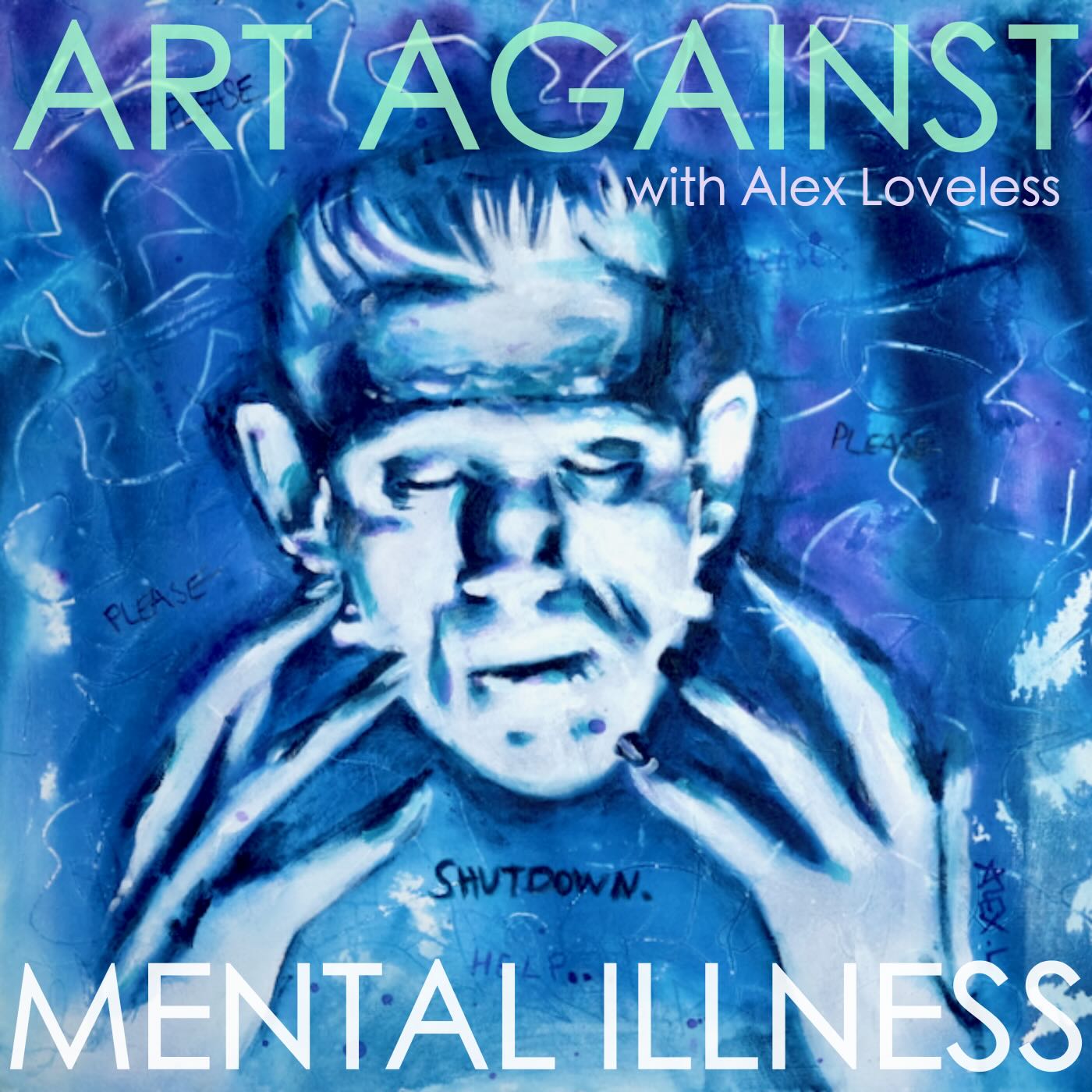
Alex revisits his 2024 episode about the role of art in society, politics and protest giving his thoughts about its increasing relevance given the events of the intervening year.
Transcript
Nobody gave me sin for this That’s reason why I try both This is all that’s old, I can see a thousand times of this Art Against Mental Illness In November 2024, shortly after Donald J. Trump was re-elected for a second term as the President of the most powerful and wealthy country on Earth, I released the following episode titled Art Against Mental Politics I was pretty angry and scared at that point, several months before the Orange Tyrant would return to office. At that point I didn’t expect good things, but I’m as stunned as everyone else at how quickly and horrifically things have unfolded. We’re now into the second year of IS, well officially it’s called a presidency, but it’s been more like a tyrannical monarchy, but let’s call it what it is, fascism. The mask is off, the gloves are off, and evil is on the march. The kidnapping of the Venezuelan President, military threats to Greenland, Cuba, Iran, armed government militia on the US streets under the guise of ICE, their murder of René Goode and others. A hateful depraved cabal of white supremacists, misogynistic oligarchs now control the USA and it affects all of us. The collapse of the established world order threatens to destabilise any and every nation. In the UK the right to protest is increasingly under attack and fascism shows its face in the form of Nigel Farage and Stephen Yaxley Lennon and their poisonous ilk. At the risk of repeating what I already said in that episode, I’ll get out of the way and let you listen for yourself, if you haven’t already. I’ll come back at the end for some closing thoughts. I tend to stay away from current affairs on this podcast. Well I have done thus far, but it’s not because I don’t pay attention to such things or because I don’t think it’s relevant to the subject. I think the events in the world around us are deeply relevant to both arts and mental health. With the world in the state that it’s in at the moment, two brutal wars and what just happened in the good old US of A, I’m recording this the day after the American election that saw Donald Trump win his second term in office. I’d argue that arts’ relationship to current affairs and politics is increasingly relevant, not just relevant but essential and urgent, which is what I want to talk about in this episode. The level of ambient anxiety all this global instability causes is not particularly good for my mental health. At times like these I try to screen out the news since it stresses me out and I have little control over it. For example, I’m not American and I didn’t get to vote in that election despite the fact that a Trump victory would and now will likely affect the security of my country. I don’t think I’m alone in wanting to open my phone on a daily basis and scream into it. Give me some good news for God’s sake. Although I’m sure Google Assistant would oblige were I to do so, I dread to think what it might dredge up. This instability is affecting the mental health of many people and this being a podcast aimed at improving mental health, it would seem a little irresponsible to knowingly inflict stuff on my listeners that I know is likely to harm their mental health. But I also can’t ignore it completely because if art does anything, it holds a mirror up to the world, to society, to culture and reflects what it sees, which is sometimes beautiful and sometimes hideous. So I’m going to talk about a few facets of the arts and their interface with current affairs, society and politics. I’m going to try not to get sucked into the specifics of what’s going on right now or soapbox on my political views, but inevitably I’ll have to make some references to real events here and there and my opinions are likely to leak out, even if only latently. So consider this your content warning. If you really don’t want a reminder of the nutso state of the world, skip this episode and maybe go listen to my calming tones on one of my other episodes. So, here goes. I deleted my Twitter account I guess maybe a year ago. I think just before it got mutated, Hulk-like, into its malignant and incessantly angry twin, X, after it was bought by King Goblin, Elon Musk. That ten of events finally triggered me to delete my account, but I’d realised long before that I needed to stay off that platform, regardless of what it was called or who owned it. Because it’s like crack to my brain, I just get sucked in. The algorithm is designed perfectly to mesmerise my ADHD brain, feeling the dopamine via little packets of outrage. I’ve heard it said that arguments are full of dopamine and as much as I loathe conflict, my dopamine starved brain will take its fix anywhere I can get it. Twitter stroke X is just one big argument these days, a stockpot of outrage and bile that’s always teetering on the threshold of boiling over. To varying degrees it always was. I used to get sucked into obsessively refreshing my feed like a chicken pecking at its food, and finding myself constantly tense and angry but still hitting refresh and getting annoyed when the algorithm wasn’t feeding me anything new. There had been times when I’ve entirely deleted the app from my phone and actually put blockers on my home network so I couldn’t access it, but I still couldn’t bring myself to actually delete my account because I had convinced myself that I needed it so I could promote my art for my job, to keep abreast of fast moving events, FOMO, the creeping insidious fear that if I did so I would be irreconcilably severed from the rest of the world to fester in abject solitude. I was like an alcoholic in recovery having a secret stash of vodka and an unmarked bottle at the back of the larder, just in case. But the elongated muskrats antics compelled me to finally kick the habit and I downloaded my history and said goodbye to the trollverse. I haven’t looked back and despite the fact that my mental health remains at best variable, at least I’ve removed one source of anxiety and negative feeling and that’s good. But here’s the thing, I’m going to get angry anyway. It’s kind of hard to avoid the news, especially at the moment given everything that’s going on. I avoid the news but then I fire up one of my favourite podcasts and here’s an advert for some current affairs show or whatever and I’m dragged right back kicking and screaming into that world. I don’t like a lot of what’s going on and I feel somewhat powerless, not completely powerless. I can choose where I direct my eyeballs, where I spend my money and how I use my vote, although the opportunity to do the latter is probably five years away in the UK. But really there’s relatively little I can do to affect the macro world situation. But I can talk, I can run this podcast and I can attempt to enrich the lives of people around me to the better and I can make art. Instead of venting my spleen via 100 or whatever characters, I can retreat to my studio and spleen vent onto a canvas. It’s an escape route where I can either simply ignore the world and or channel my reactions into an artwork. I create paintings at parcels of escapism, both for me and hopefully for the viewer. Some of my works from about five or six years ago, around the time of Brexit in the UK, were either overtly or covertly political. I would weave in cutting some newspapers and bits of social media and magazines and stuff and I would have collages with some themed pictures over the top of them taken from a movie or whatever. To make some point about the state of things. I was making slightly clumsy but heartfelt comments about the absurdity of the world around me. I incorporated images of political figures who I found repellent. This for me is partly at least an exorcism of demons by depicting and making fun and critiquing these people who I disagree with on almost a molecular level. It takes the place of me ranting and raving and moaning and boring and baiting those around me. It feels like I’m doing something positive or at least something. Whether or not these messages will reach anyone or whether or not people understand or interpret these works as I intended them. And if they could, whether it would at all affect their opinion on any of these matters, I don’t know. I doubt it. Some of my motivation here is to make a statement so I can say in the medium that I’m comfortable with I’m not okay with this and to connect with people who are also not okay with this. If I can change someone’s mind on a subject then great but I strongly suspect that this almost never happens. And it’s pretty well understood in psychology that reason persuasion is usually counterproductive in terms of trying to win people over to your argument. Art is a medium for communication and therefore that’s what I’m doing. And I’d rather show someone something that I made that they can appreciate and enjoy while also containing a message than getting on a podcast and ranting about the state of the world. I’m certainly not alone in using my chosen artistic medium to express my dissatisfaction. Picasso, responsible for perhaps the most famous piece of political or protest art before Banksy turned up, the Guernica, stated that art is a lie that makes us realise the truth. He’s saying that by making fictional things we highlight real things in the real world. His famous and giant painting was a comment on the horrors of the Spanish Civil War which, in his words, clearly expresses my abhorrence of the military caste which has sunk Spain into an ocean of pain and death. The history of protest art is at best diffuse but examples of it have been traced back to ancient Egypt. More recent early examples can be found in the likes of Francisco Goya’s series of 82 print depicting the horrors of the peninsula war with terrifying unflinching honesty in the early 19th century. But it was in the 20th century that protest art really became a cultural force. From the anonymous feminist activism of the Guerrilla Girls, through Keith Herring’s vibrant, playful but deadly serious graffiti, to Pussy Riot’s very public displays of performative, punkish discontent. About his 1917 work The Funeral, German expressionist George Gross said, In a strange treat by night, a hellish procession of dehumanised figures mills, their faces reflecting alcohol, syphilis and plague. I painted this protest against the humanity that had gone insane. Chinese artist and exile Ai Weiwei dedicates his life and works almost entirely to political protest and makes works across a dizzying array of styles and mediums including sculptural installations, woodworking, video and photography. He stated that the world is not changing if you don’t shoulder the burden of responsibility. Grace and Perry’s illustrated vases and other knick-knacks are elaborate narratives packed with rice social observation and political comment. Jenny Savile’s news wage war on society has warped expectations regarding the female form. Music is awash with protest. Folk legend Woody Guthrie’s guitar was adorned with the slogan, This machine kills fascists. Bob Dylan’s early work, Billy Bragg, Joni Mitchell, Bob Marley, hardcore punk legend’s minor threats, clean living polemicism, public enemies intimidating black power hip-hop, Queen Bey’s world-conquering feminism, K-10 pest poetic bile and beauty, Pink Floyd, Rage Against Machine, Lamb of God etc etc. In the movies we have Doctor Strange Love on Nuclear War, Dawn of the Dead takes aim at consumerism, Apocalypse Now on Full Metal Jacket on Vietnam and more recently Don’t Look Up on Civil War. Turn their sights to modern day USA. I don’t even know where to start with literature. Orwell, Brave New World, Fahrenheit 451, Slaughterhouse 5, Catch-22, Silent Spring, Handmaid’s Tale, American Psycho, 50 Bloody Shades of Grey. Many claim that Lord of the Ring, despite Tolkien’s protestations to the contrary, is awash with social commentary. I was going to TV, the stage performance art and so on, but I can’t very well just sit here listing things now, can I? Suffice to say that if you are under the delusion that the arts should keep their nose out of society and politics then I’m afraid you’re going to be disappointed. And precisely because some people think such things, the arts are so important to the function of society. I don’t have to look very far to see the evidence of those seeking power to curtail the ability of the arts to critique them. The UK has seen huge cuts in arts funding, especially in schools over the last decade or two, and even direct attacks on our cultural institutions such as the National Trust, the BBC and Channel 4, although it is fair to say that our film industry is booming. We see similar manoeuvres in patches all across the world as wannabe despots spring up all over the place. Those with totalitarian leanings don’t tend to like being critiqued, and most see the arts as their natural enemy along with protest and free speech. Because if people can hold a mirror up to society then you’re also holding a mirror up to its leaders. I don’t think anyone, regardless of where they sit on the political spectrum, enjoys being criticised. But people who are truly democrats, as in small d democrats, understand that criticism, free press, right to protest, right to criticise the government are essential for a functional democracy and the correct course of action when criticised is to either change course or justify your actions. As much as the luxury of freedom of expression is only somewhat afforded to us in the UK, Europe and America, there seems to have been a creeping view from the political extremes that freedom of the arts and freedom of the press is not optimal for the society that they envision coming about, or in China and Russia’s case that they wish to maintain. Artists and creators tend to be quite high on the empathy scale, and because of this we recognise and reflect the cultural undercurrents of human society, and therefore not only do despots see the arts themselves as a threat, they also see artists as a group of people who are inherently opposed to their ideology. Despots crave a certain kind of order, one where everything points towards them and their bloated ego. The centre’s a dirty smudge on a clean, orderly world they crave, and therefore must be extinguished. So you lock up your critics and can tell the arts, one of the most important doctrines in the fascist playbook. A functional society needs to be able to express itself, it wants to be able to express itself, and freely. We might be pack animals, but there are lots of packs out there, and they don’t all want and need the same things. Therefore, if you want society to fall neatly in line, you have to use force, which is inevitably the way for tyrants. But it’s a hard regime to maintain and fraught with pitfalls, and most despotisms usually fail under the weight of their own psychosis. Art is communication, and the number one requirement for a functional despotism is to control communication. I don’t think many people would knowingly wish fascism upon themselves. Yes, the Nazis came to power democratically, but I’m not sure the German people really knew what they were getting themselves into. One way or another, Hitler preyed on the desperation created by the reparations to serve his own needs, and created a big evil mess in the process. Ultimately, as the same member of a functional society, you want people to feel free to express themselves, to communicate, because that’s how humanity progresses, that’s how culture evolves. That’s what’s enabled innovation in technology, healthcare and entertainment that’s made us safer, longer-lived, with richer, more varied lives. It’s enabled some much less healthy stuff too, but that’s for another day. A functional society needs the arts. It may not be that everyone in society appreciates the arts equally, but you’ll be hard-pressed to find someone who doesn’t watch TV, or movies, or YouTube, or play games, or listen to music. And so the arts do impact on everyone’s life to one degree or another, even if they don’t think of it that way. And if you constrain the arts, you constrain what people can do and say, you’re by definition constraining creativity and freedom of expression. And yes, of course, there’s certain areas that fundamentally shouldn’t be allowed because of the harm and horror they would afflict on the people who can’t otherwise defend themselves, i.e. children. But in terms of just creating art that has a functional, non-destructive role in society, you need creativity. People need fresh culture pretty much constantly. That’s why people turn up week after week to watch the next episode of their favourite soap, Love Island, or the next Mr Beast video, because it’s new, fresh. And enabling that needs creativity and freedom to express. And the more you constrain that, the less new things come about. So yes, of course, you can take the same few chords on the guitar and create a huge number of different songs with them. But eventually that’s going to sound stale and boring and monotonous, and people will tune out and or demand something different and new. At its most benign, the arts provide solace and escape from the wearying world for both the creator and the consumer. I know that that’s the case for me. It’s not solely world affairs that erode my mental health, but it’s a major factor. Being able to channel my fear and frustration into artworks is a vital cathartic release and shelter from the constant barrage of bad news. For all of us, such a refuge can provide the vital breathing space to recharge so that we may resume the fight revitalised. So ultimately, restricting the arts leads to a less healthy society, both physically and psychologically. And if you want your society to be optimally functional, then you need them to be healthy and happy, and therefore the arts need to be available and unconstrained. So far from being apolitical, the arts are integral to societal stability, not to mention the money they make for those who create and the richness brought to people’s lives because of them. Whether your art is explicitly political or purely aesthetic, your freedom of expression, to choose what to represent and how, is a reinforcement of liberty and a middle finger up to tyrants. To quote German poet and playwright Bertolt Brecht, art is not a mirror held up to society, but a hammer with which to shape it. Next time you find some space for creativity or when you find yourself experiencing some great art, which is basically constantly, remember this. In itself, it is an act of defiance. Defiance of the status quo and the defiance of all those who seek to perpetuate the status quo for their own malignant ends. Art is change, be the change. Okay, okay, I’m climbing down off my soapbox now. I’ll stay off it for a little while, not least because I’m apoplectically sick of all of it. It’s making me so sad and tired, but I should say that I’m not shy with expressing my political views, nor am I embarrassed by or ashamed of them. And I doubt it’s hard to either discover or infer my political leanings. But one of my key aims with this podcast and my artistic endeavors in general is to bring people together, to help them exchange ideas, communicate, empathize. If I use this channel as a platform for broadcasting my political views, all I will do is alienate large swathes of people and what’s that really achieving? Most of the most pervasive and destructive problems we observe in the world at the moment, which includes epidemic and endemic mental illness, is division. It’s less about left versus right and liberal versus conservative, and more about a lack of communication, mutual understanding, empathy, community and shared goals. If you bring people together, they talk. If you guide people to the act of creation, the solace they find in it will help them be more open-minded and empathetic to the world. A few more mentally healthy people in the world can’t be a bad thing, right? As I said in this episode, I’ve tried not to be too political in this podcast, as I want it to be as inclusive as possible. And if my intention is to help people maintain their mental health, politics isn’t exactly the best subject. But ultimately, I think we’ve passed the point where we can ignore what’s going on as it’s coming to our door in the near future, whether we like it or not. If this moment in time is anything, it’s disempowering, which is exactly how the bad guys want us to feel. As I observed in this episode, one of the first things that fascists do is curb and control the arts. Expression, creativity and originality are antithetical to fascism, which craves all the conformity and deference. I’m not suggesting that artists and creators have the responsibility to become the literal resistance. As per the core thesis of this podcast, art should feel like a refuge if it’s to help us manage our mental wellness. I’m saying that in these increasingly depressing times, art, whatever that means for you, is more important than ever, for both creator and consumer. If what you produce is sieving landscapes or chill, cheerful music or escapist fantasy romance stories, then the world needs you. If you make confrontational, cathartic, aggressive paintings, punk music or movies, then the world needs you too. If you make art on your own, for yourself and never show it to anyone else, that’s equally important. Creation is always an antidote to evil. Evil only knows how to destroy and control. It hates beauty, honesty, heart and soul. Creation brings these things, so regardless of how you practice creativity, you are already the resistance. Keep on resisting.Show Notes
Alex revisits his 2024 episode about the role of art in society, politics and protest giving his thoughts about its increasing relevance given the events of the intervening year.