Sharing Is Caring...Amen Brother!
Posted on Saturday, Mar 22, 2025 | Mental Health, Art, Creativity, Mental Illness, Art Therapy, Creativity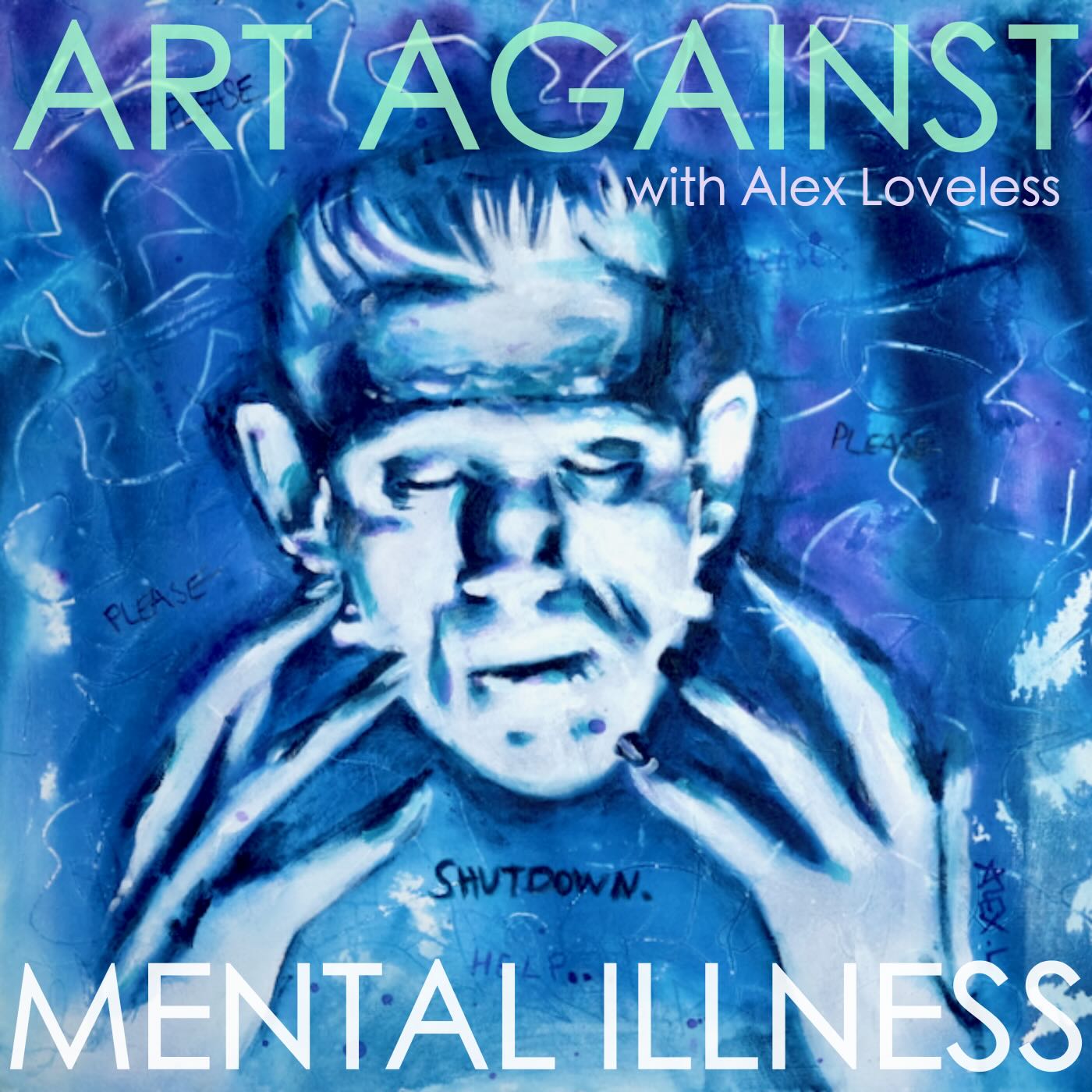
Alex introduces his new cover image and intro track and takes us on a journey through their creation, meandering through the creative commons, via the enchanted lands of the Amen Break before falling into the foetid swamp of copyright to learn that sharing is indeed caring. Amen!
Transcript
Welcome to the Art Against Mental Illness podcast. My name is Alex Loveless and this is… Don’t I can see about the time of day. Art Against Mental Illness. Whoa! What was that? A new intro? Surely not. My ears deceive me. It surely is though. The joyous extravagance is never end. It’s like the Reformation all over again. Today I’m going to talk about how and why I did this, which will take us on a journey through the art of borrowing and the borrowing of art, including a stroll across the creative commons and a way through the swamp of copyright. Why? Because sharing is caring and this is a podcast about both of these things. Buckle in folks, things are going to get a bit turbulent. First off we’ll start with the easy bit. Why? Let’s start with the cover image. My prior cover image was, and probably still is in various places, a depiction of Boris Karloff as Frankenstein’s creation from James Wells’ seminal and iconic 1931 movie Frankenstein. It’s from this movie that we have the classic image of our mate Frankie with a flat head and neck bolts, as well as a bunch of manic professor-stroke scientists with beleaguered servant named Igor memes. This film also generated a wrath of misconceptions about the contents and interpretation of Mary Shelley’s masterful 1818 novel of the same name. In Shelley’s novel, both the prof and the putative, monster in quotes, are complex and articulate characters. The story arc is one of morality, ambition, revenge, abandonment, isolation and consequence that poses philosophical and ethical questions surrounding creation and responsibility. The film, on the other hand, is about a nut job who makes a scary dude from bits of other dudes who is basically decent but is misunderstood and ultimately hounders to death by reactionary and ignorant locals with pitchforks and burning torches. No highly topical social, moral or political subtext to be detected there. Anyway, I digress already. Back to the matter in hand. The Karloff-Frankenstein character, or perhaps caricature, became a bit of an avatar for me after I painted a depiction of it in Dayglowing Pasto back in 2018 when I’d recently started making art seriously again. It was a meditation on my damn recent ADHD diagnosis and the fact that I’d always felt a little like a person made up of bits of other people, none of which seemed to fit comfortably together, and that I’m tall, have a latently intimidating aura, essentially resting bitchface of the entire being, and also tend to say and do things that make other people uncomfortable. No pitchfork wielding peasant hordes yet, though, thankfully. Frankie has since turned up in various artworks, the most recent being that of my cover image, depicted in blue and white with the words Help and Shut Down written on it. This was created during a very dark moment during one of my life’s darkest periods, sometime in spring last year, 2024. When I started this podcast soon after, pretty much on a whim, I realised that I needed a cover image and wanted to use something that I own the rights to. This image presented itself as an obvious contender, both in terms of subject and tone. It worked well in multiple different sizes and would be memorable, so I started using it without giving it much more thought. Now, the eagle-eyed of you will have spotted a flaw in this plan. I may own the copyright of my depiction, but I do not own the copyright of the original image from which it was taken. That is owned by Universal Pictures and will be, barring any legal intervention until 2027. I was latently aware of this being a potential problem, but largely wafted it psychologically away as probably not mattering, because the film is so old and who’s going to give a toss about an irrelevant little mental health podcast that probably no one will ever listen to anyway. That is the way it stayed until a month or two ago when I received an email from Google’s search team informing me that the website for this blog contains unauthorised use of copyrighted material not owned by me. If I didn’t remove it, they would delist my sight. Not the end of the world for sure, but I certainly felt seen and not in a good way. It’s the first time I’ve encountered any such action. It struck me as possible that I might get pursued via potentially more detrimental avenues that would seem my modest little show eradicated from the web. This may seem a little hyperbolic, and probably is, but as a law-abiding citizen and lifelong paranoiac I felt compelled to act, if only slowly, you know, to stick it to the man good and proper. So here we are. I now have a somewhat more prosaic, less lyrical and more generic cover image that I like much less, but using photos that I took of semi-artistic blobs that cannot possibly violate someone else’s copyrighted property. Hopefully anyway. I’ll probably change it soon anyway, or maybe wait until 2027 and change it back to Frankie. Watch this space. Anyway, I figured that since I’m changing that, I might as well change the other thing that I’ve been meaning to change since practically day one. My intro track. It was done hastily in the early days before I really knew what this would become. Well, I still don’t know what it really is, but at least I know that. Incidentally, the music I used in my original intro was one of the stock clips that were available from my editing service, Descript. So although I don’t own the copyright, I have the de facto permission to use it. At least that’s how I understand it. Hopefully I understand it correctly. So I set about conceiving of something new that would truly foreshadow the majesty and the magnificence of this podcast on a weekly basis. This is where things get much more fun and psychedelic. What I wanted was relatively simple, some signature music and some rendition of the podcast title. I needed it to be 10 to 20 seconds long and have a fade out that could be crossfaded with the start of the episode proper. But how to do all this without falling into another copyright ditch and also have it not sound crap? I’ve actually already got all the requisite skills to do this. I’m somewhat musical. I play the guitar, if not particularly well, and I know a few piano chords and have a rudimentary understanding of music theory. I also learned enough sound editing to make a podcast, obviously. What I decided that I wanted was a short section of music that felt both maudlin and somewhat light-hired, which is essentially the tone I set here on a weekly basis. I had zero confidence in my ability to write or record such a thing despite broadly having the skills to do so, so I decided to see if there was anything in the public domain that would fit the bill. I thought maybe it would be good to get an ancient recording of some old blue standard, partly because it seemed appropriate and partly because I figured I could find something in the public domain. What do I mean by public domain? Here’s a summary that ChatGBT gave me performed by ChatGBT itself. Public domain refers to creative works that are not protected by copyright and are therefore free for anyone to use, modify, and distribute without seeking permission or paying royalties. This can include works whose copyright has expired, works created by the government, and works that have been explicitly placed in the public domain by their creators. In essence, public domain works are available for public use and can be accessed by anyone for various purposes, including education research and creative projects. There are various sites out there that make public domain works available. Pixabay is a good example. You can find all sorts of free-to-use digital delights on here. I’ve used it for various other projects. However, the track that I eventually found was from another site called the Open Music Archive. There’s lots of old copyright expired tracks on there, mostly from the 1930s and earlier, that predictably skew towards blues and jazz. It’s quite a treasure trove. I stumbled across my track by scanning through titles to see if they sounded appropriate. Any along the something blues blueprint would do the job. I created a shortlist and then listened to each to see if there was anything in there that I could make sense of using. Standing head and shoulders above all the other contenders was the wonderful Poor Me Blues by Edna Hicks. It had everything. The perfect title. It was whimsical and slightly morose, a crackly old sound, a song with an early big band bluesy feel which had a chunk in the middle that was both lyrically and musically perfect for what I wanted. Bam! Ms. Hicks back catalogue, as modest as it is, contains a plethora of other similarly titled and themed ditties, including hard luck blues and down-hearted blues. Poor Me Blues was recorded in 1924. The now little heard of blues singer’s repertoire was recorded between 1923 and her untimely death at the age of 30 in 1925. Her death at such a young age adds a further sense of pathos to the track, as does the bizarre and almost comically horrific manner of her death. Here is quoted on her Wikipedia page. In August 1925, while assisting her husband in filling their automobiles gasoline tank, she was burned after splashed gasoline was ignited by the candle she was holding. She died in a Chicago hospital two days later. Wow! I mean, wow! I suspect that untimely demises the discheimer depressingly common in those days. Anyway, this all added to my somewhat morbid obsession with the track. So why is this track in the public domain? Well, the US copyright on a particular work is held for a maximum of 95 years from the date of publication before it defaults to the public domain. Well, sort of. It’s complicated. Many works published prior to January the 1st 1930 are now in the public domain. Since 1978, there’s been a law that copyright for works published after that year is held for 70 years after the holder’s death. So although this doesn’t apply to Edna’s work, it would still be out of copyright by the modern laws. So I get to use and abuse it. But the track didn’t fill enough on its own. I wanted to put my mark on it and give it a bit more of a modern sheen without violating its degraded dusty majesty. Maybe some modern sounding synth noises and chords. I own an Apple MacBook. Macs can bundle with an app called GarageBand, which is an entry-level recording, production, sequencing and midi suite. I say it’s entry-level, but it’s pretty extensive and flexible. Just not a professional bells and whistles studio software like Cubase or Ableton or Pro Tools or a bunch of others you’ve probably not heard of if you’ve never done any music or sound recording. I have a small cheap midi controller keyboard, which is the piano equivalent of your QWERTY keyboard in that it doesn’t do anything itself. It just passes signals to some software that then makes the sounds or triggers samples or whatever. Midi controllers are to a piano what a computer keyboard is to a typewriter. So I plugged in and started making noises. Now, I want you to note at this stage that I have thus far only used stuff that is either freely available or something or part of something that I already own. So no money has been expended, which is good because I ain’t got any. This lack of expense is important because it forms a backbone of my thesis for this episode as alluded to in the title. I ended up finding a suitably futuristic synth voice from GarageBand’s repertoire and imputed some of the notes from the song by simply hitting keys until I found the ones that sounded right. This is really the extent of my piano ability. I didn’t even need to find the chords since the synth voice fleshed out the sound in such a way as to sound like chords. The wonders of modern technology, eh? I also cobbled together some background atmospherics from GarageBand to flesh out the mix a little bit. These would eventually sit pretty far back in the mix as to be barely noticeable, but offer a latent sense of depth and atmosphere. Listen to me getting all music techy. You’d always think I know what I’m doing. Next, I needed to mix all these together since they were all from different sources. One of my go-to tools for creating my podcasts is an open source sound editing software called Audacity. What is open source, you ask? Chat jeopardy charoo. Do your thing. Open source software is software that is released with a license that allows anyone to view, modify, and distribute the source code. This means that users have the freedom to use the software for any purpose, study how it works, change it to suit their needs, and share their modifications with others. Open source software promotes collaboration and transparency, often leading to more robust and secure applications due to the contributions of a diverse community of developers. Examples of open source software include the Linux operating system, the Apache web server, and the Mozilla Firefox web browser. I use open source software all the time. In my day job as a data scientist, I use a suite of tools around the open source programming language Python, which has a vibrant collaborative community of developers creating libraries and extensions for Python which are shared for anyone to use, free of charge. The server that hosts this podcast uses the Linux operating system, HugoCMS, and web server Nginx, all of which are open source, community managed, and free to use. I could go on, but this is an art podcast, not a computing one. Suffice to say, I don’t like paying for software and I can’t really afford to anyway. I do for some stuff, for example, Descript, but that’s the exception rather than the rule. The open source software movement has a long and rich heritage and spearheaded many of the technical innovations we all take for granted these days. The internet basically runs on open source software. The concept of sharing for the greater good is not only in the DNA of open source development, but is enshrined in law by the licensing. This is essentially anathema to the Uber capitalist and the tragedy of the commons crowd, but screw those blowhards. The open source movement bled its way into the creative arena by way of the creative commons. Here’s Chassie McChack GPT face again. Creative Commons was founded in 2001. The organization was established to provide a flexible range of protections and freedoms for authors, artists, and educators, allowing them to share their creative works while still retaining some rights. Creative Commons is a nonprofit organization that provides free licenses and tools to enable creators to share their work legally while retaining certain rights. These licenses allow creators to specify how others can use their work, whether it’s for commercial purposes, modifications, or sharing. The goal of Creative Commons is to promote the sharing and use of creativity and knowledge through legally sound means, making it easier for people to access and build upon the work of others. There are several types of Creative Commons licenses, each with different permissions and restrictions. So using my special powers of free softwareness, I merged and mixed my audio niblets. It sounded nice, but it felt like there was something missing. I wanted to give it a bit more punch, make it a bit more spicy, more zesty. I needed some beats. So off I went for a leisurely stroll around the Creative Commons to see if there was any beat samples I could use or abuse. The answer be it’s way out of me. See what I did there? Pretty much immediately. This final piece not only put the proverbial cherry on top of my Bakewell tart, but led me and therefore you down a rabbit hole that rounds off our Odyssey of sharing. The eagle-eared among you will have noted the funky beat that I used and known exactly what it is and how important it is. Here it is on its own so you can hear it properly. What you just heard is arguably the most important six seconds of music ever recorded. Seriously. You’ve probably heard it about a thousand times in one form or another. You may well hear it again before the day is out. It’s that ubiquitous. It’s called the Amen Break and it’s legendary. So where does it come from and why is this six seconds of funky drumming so damn important? I’m going to give you a compact story here because there are many sources that will do it more justice than me. I’ll put some links in the show notes. A lot has been written about it so you won’t struggle to find more info. The Amen Break comes from the 1969 track Amen Brother by American Soul Group the Winstons released as the B site of the 1969 single Color Him Father. The drum break itself lasts seven seconds and was performed by Gregory Coleman. So far so mundane. It’s a decent track you should go listen to it but it ain’t going to change your world and it gives no hint of its subsequent importance to musical history. To understand why it became so important you need to understand what sampling is. In the 1980s with the rise of hip-hop DJs began using turntables to loop drum breaks from records which emcees would then wrap over. This is of course trivial with modern digital kit but back then it was a real innovation. This was adopted rapaciously by the nascent hip-hop scene centered around New York. Arguably the most iconic example of this is Rapper’s Delight by the Sugarhill Gang which samples Sheik’s glorious hit single Good Times. In 1986 Amen Brother was included on Ultimate Breaks and Beats a compilation of old funk and soul tracks with clean drum breaks intended for DJs. Salt and Pepper’s 1986 single I Desire has one of the earliest uses of the Amen break. Perhaps the most conspicuous and famous example is on NWA’s iconic and controversial single Straight Outta Compton. But it turns up all over the place. Often either sped up or slowed down and more often not only using the first two bars. Here’s a selection of tracks that feature it. The project is Minefields and Fire Star both from Fat of the Land. Tyler the Creator’s Pigs. Oasis, do you know what I mean? Nine Inch Nails, the perfect drug. Slipknot, Eyeless and Pulse of the Maggots. Skrillex, I Know Who You Are, Plan B, Ill Manners, Amy Winehouse, You Know I’m No Good etc etc. So it’s not just confined to hip-hop. Indeed the entire genre is a drum and bass and jungle essentially owed their existence to the loop and cut up, rearranged and sped up versions of it. As I say most uses only feature the first two bars. This is because the third and fourth bars use a syncopated pattern that is not quite so satisfying or easy to loop. I’d like to point out that my intro uses the whole thing albeit slowed down quite a bit. The use of the Amen break and other samples highlights a relentless DIY creativity of the early hip-hop scene, one of the most inventive and important movements in music history. If you want to understand more about this fascinating scene I can recommend the first few episodes of Netflix’s hip-hop evolution. It’s both fascinating and inspiring. The use of samples was largely nixed in the late 80s and early 90s when, surprise surprise, the corporations and lawyers got involved after they sent a rich scene of copyright cash to mine. It quickly became financially and therefore creatively prohibitive to use samples since doing so with resulting having to pay royalties to the sampled artists. It obviously continued but only for those with very deep pockets. The copyright on the Amen break has never been contested from Wikipedia. The Winstons received no royalties for the sample. The bandleader Richard Louis Spencer was not aware of its use until 1996 after the statute of limitations for the copyright infringement had passed. He condemned its use as plagiarism but later said it was flattering. He said it was unlikely that Coleman who died homeless and destitute in 2006 realised the impact he had made on music. More tragedy but his name will be honoured for many years to come. I think that attempting to enforce the copyright on the loop would be an expensive gargantuan and soul-destroying task, not to mention deeply unpopular. The version I use is actually from a public domain recreation of the loop taken from Pixabay. I slow it down to roughly align with the clip from Poor Me Blues and apply some light distortion and reverb. I think it sounds great. What drew me to the sample, apart from how awesome it sounds, is what it says about the act of artistic borrowing and how essential this is to the artistic process and history. There’s an incredible video about the Amen break on YouTube originally recorded in 2006. Here’s a section of it since it makes my point much more eloquently than I ever could. In other words, not only does the innovation within culture grow when copyright is flexible, so do its markets and capital. New trends are developed, new sounds are sought after, new releases are anticipated and become hugely popular. Perhaps even selling out, new stars are born and new fan bases are created. Money is exchanged, all in the pursuit of new forms and experiences, of potentials for new connections and meanings. I think the history of the use of the Amen break demonstrates this. To cite Federal Ninth Circuit Court of Appeals judge Alex Kaczynski, quote, over-protecting intellectual property is as harmful as under-protecting it. Culture is impossible without a rich public domain. Nothing today, like nothing since we tamed fire, is genuinely new. Culture, like science and technology, grows by accretion, each new creator building on the works of those who came before. Over-protection stifles the very creative forces it’s supposed to nurture, unquote. I’ll put a link in the show notes and I urge you to go listen to the whole thing. It’s only 20 minutes long and it’s absolutely fascinating. I’ll also include a link to another video that deconstructs the Amen break beat by beat that’s also super interesting. My point with this is not that copyright is inherently bad. It’s actually essential for creators like myself to protect what little livelihoods we can derive from our art. But as the quote from Kaczynski suggests, over-enforcement is every bit as detrimental as under-enforcement. And indeed, as the open source and creative commons movements demonstrate, making art or intellectual property available to be freely used can benefit everyone, including the creator. It’s also worth noting that much copyright enforcement is bad faith and often frivolous. Take Lars Ulrich’s tone-deaf reaction to his own fans obtaining Metallica’s music via Napster in the early 2000s. I also urge you to familiarise yourself with the story of Australian mega-hit We Live in the Land Down Under by Men at Work, which demonstrates the tragic consequences that cynical, for-profit copyright enforcement can have. There’s an episode of Tim Harford’s excellent podcast, Cautionary Tales, about this. Again, check the show notes. Much of my own work is dubious from a copyright perspective, as demonstrated by the Frankenstein affair recounted at the top of this episode. I often use stills from movies and popular culture and remixed them to take on a different form and meaning. I certainly didn’t set out to steal anyone else’s work and I certainly don’t think I’m causing any harm, and I’m certainly not profiting from it. I just saw images I like and I wanted to depict them. My belief is that sharing is caring and take no issue with good faith and properly attributed use of my own work. I consider it my duty to my species. Running a podcast is a minefield from a copyright perspective. I refrain from using any of the clips from the songs mentioned in this episode for this reason. Even using a small section of copyrighted music could see me liable to royalties or fines. I actually have a reasonable argument for what’s called fair use. Since this podcast, or at least this episode, will be considered educational, I could potentially use very small clips and claim fair use. But it’s just too risky. The last thing a fledgling podcast like this needs is that sort of legal exposure. The cover image thing is already bad enough. Borrowing, paying, homage and emulating are all essential to creativity and art. There is nothing that is truly new. Every creative act stands on the shoulders of giants, each of which stands on the shoulders of giants, in a regress that stretches back thousands of years and probably longer. I could and probably will do a whole episode on Famous and perhaps some infamous acts of borrowing. There’s also a lot to be said in the wholesale theft of intellectual property and copyrighted material without permission by AI companies like OpenAI, Anthropic and Google to train their generative AI models. I recognize that my use of chat GPT on this and other episodes seems a little hypocritical. However, I do not use these tools for creative uses and much of what I get from them is factual information that’s freely available from websites such as Wikipedia. However, this use is as ethically dubious as my use of copyrighted images in my paintings. It’s not something that I’m particularly comfortable with, along with the fact that I’m helping to fund objectively horrible people such as Sam Altman and generating arguably avoidable extra carbon. However, these AIs aren’t going to go away and use correctly and responsibly are extremely useful tools. I’m also required to have extensive knowledge about large language models for my day job. It’s complicated. I regularly review my stance on this and will continue to do so. In the meantime, feel free to copiously call me a hypocrite because I probably am. As you can see, it’s possible to be on both sides of this at the same time. Both the violator and the violated, the criminal and the victim. And it’s possible to be in ambiguous territory with both. If you can tell I’m tied in knots on this subject, then you’re right. Copyright is a dense, thorny bush of impenetrable language and unfathomable laws. Successful policing of copyright is a delicate balance of robust and balanced lawmaking and sensitive, thoughtful enforcement. And it’s also not working right now for most people. As much as copyright protections like society in general are unbalanced right now, favouring those with the money to buy the legal clout, it is at least easy to see how complicated it is to maintain this delicate balance, especially in a world where the market for creativity stretches across almost every border, culture and economy. To say that I haven’t done this subject justice is an abject understatement. I set out to take a leisurely and somewhat light-hearted sojourn into this perilous arena and realised too late that I’d not stumbled into a friendly badminton knock-around, but more like a free-for-all ice hockey brawl where only some players are allowed to wear protective gear. I guess sometimes, in the name of helping mental health, I need to occasionally stray into subjects and areas that are patently bad for it, if I need to point out that they’re there. I step into the bear trap so Jarl can avoid it. I desperately don’t want these issues to prevent anyone from expressing their creative spirit, but the moment you make your work available to others, these factors come into play. I guess my advice here is to largely forget about it all. Just keep it all in mind when either making your own work available or borrowing from someone else’s work. Always stay true to the spirit of sharing is caring while remaining ready to protect yourselves against cynical or bad faith attacks on your rights. How do you do this? I’m not a lawyer or even particularly well versed on this stuff. I try to know as much as I need to know to keep myself straight. I’m really just here to point and be so you’re aware that it’s there and can decide what action to take. Maybe chat GPT can help with that. Thank you again folks. I’ll be back soon. In the meantime remember to like, share, rate, review, tell your friends, your dog, your partner, random person on the street to listen to this podcast. Also go listen to my other podcast, it’s called Creative Squares where me and Mark Burden talk about the overlap between the arts, science, maths and technology and I’ll see you all again soon. And to lead us out, for no other reason than I thought it would be funny, here’s chat GPT reciting the first few verses of Lewis Carroll’s amazing poem The Jabberwocky, which irritatingly it did really well. Bye. Twas brillig and the slithy toves did gyre and gimbal in the wave. All mimsy were the borogoves and the moamraths outgrave. Beware the jabberwock my son, the jaws that bite, the claws that catch. Beware the jibja bird and shun the frumious bandersnatch. He took his vorpal sword in hand, long time the manxom foe he sought. So rested he by the tum tum tree and stood a while in thought. And as in uffish thought he stood, the jabberwock with eyes of flame came wiffling through the tulky wood and burbled as it came. Alls against mental illness.Show Notes
Summary
Alex introduces his new cover image and intro track and takes us on a journey through their creation, meandering through the creative commons, via the enchanted lands of the Amen Break before falling into the foetid swamp of copyright to learn that sharing is indeed caring. Amen!